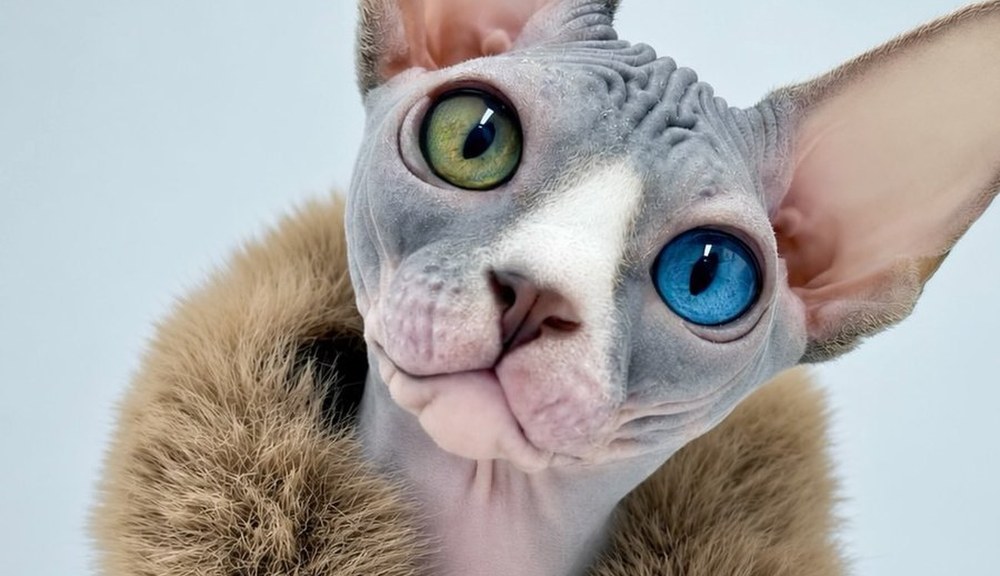
Why Are Sphynx Cats Hairless? The Genetics Behind the Breed
Nobody designed the Sphynx. The breed exists because a natural mutation turned up in an ordinary litter of farm kittens, and people decided it was worth keeping.
A Canadian barn, 1966
A domestic cat in Toronto produced a hairless kitten named Prune. Breeders worked with him and with hairless cats found later in Minnesota and Toronto in the 1970s, crossing them to coated cats — Devon Rex among them — to build a gene pool wide enough to be healthy. The modern Sphynx descends from those few founders, which is exactly why responsible breeding and health testing matter so much in this breed.
Earlier hairless cats had appeared before, including the Mexican Hairless cats documented in the early 1900s, but that line did not survive. The Sphynx as we know it starts with those Canadian and American foundation cats.
Formal recognition followed the breeding work: The International Cat Association recognised the Sphynx in 1986, and the Cat Fanciers Association in 2002.
What the gene actually does
Sphynx hairlessness comes from a variant of the KRT71 gene, which is involved in building the keratin structure of a hair. The variant disrupts that structure, so hairs form abnormally and are mostly lost — which is why a Sphynx is usually not truly bald but covered in a fine down, like the skin of a peach, with fuzz that often persists on the face, ears, feet and tail.
It is recessive. A kitten needs the variant from both parents to be hairless; a cat with one copy has a coat but can pass it on. Interestingly, the same gene in a different variant produces the curly coat of the Devon Rex, which is a neat hint at their shared history.
Why that matters for a Donskoy
The Donskoy is also hairless, and people assume it is the same cat with a different name. It is not. Donskoy hairlessness arises from a different, dominant mutation, so a single copy is enough to produce a hairless cat. That is a genuinely different inheritance pattern with different breeding consequences, and it is the reason the two breeds should not be crossed. We keep both, and we keep them separate.
What hairlessness changes about the cat
No coat means heat escapes faster, so a Sphynx runs a higher metabolic demand, eats more than you expect, and hunts down every warm surface in the house. Skin oil that a coat would wick away instead builds up, which is why bathing is part of routine care. Bare ears collect wax, bare skin can burn in the sun, and bare bodies feel remarkable to hold — warm, soft, faintly suede-like.
None of that is fragility. It is simply a cat with the insulation removed, and once you keep the house warm enough and the skin clean, you have a normal, robust, extremely opinionated cat.
What the genetics mean for your shopping list
A coat is insulation, sun protection and a grease cloth all at once. Take it away and those three jobs become yours, which is why a hairless cat’s kit list looks nothing like a coated cat’s.
Gentle shampoo formulated for hairless skin
Skin oil that a coat would normally wick has nowhere to go, so bathing replaces brushing.
Adjustable-temperature heating pad
Warmth is not a luxury for a cat with no insulation. Adjustable heat and a chew-resistant cord are the two features worth paying for.
Cotton-blend turtleneck for hairless cats
Clothing does the insulating job the coat used to, and doubles as sun cover indoors.
These are Amazon affiliate links. If you buy through one it can earn us a small commission at no extra cost to you. We only list things we own or would buy again — the full list is on Our Favourite Things, and how we handle commercial relationships is set out in our affiliate and editorial disclosure.
Meet the cats behind the advice
Everything here comes out of running a household of Sphynx and Donskoy cats — meet the queens, studs and kittens, or send us an enquiry if you have a question we have not answered.
Frequently asked questions
- What gene makes a Sphynx cat hairless?
- A recessive variant of KRT71, a keratin gene needed to build a normal hair shaft. A cat needs two copies to be hairless, so two hairless parents always produce hairless kittens.
- Where did the Sphynx breed come from?
- From a hairless kitten named Prune, born to a domestic shorthair in Toronto, Canada in 1966, later crossed with Devon Rex lines that carry a related KRT71 variant.
- Is a Donskoy the same mutation as a Sphynx?
- No. The Donskoy carries a dominant mutation found in Rostov-on-Don, Russia. Crossing the two breeds is discouraged because the coat genetics interact unpredictably.
- Are Sphynx cats completely bald?
- Rarely. Most have a fine peach-fuzz down, with denser hair on the nose, ears, feet and tail. Fully bald skin is one end of a range, not the standard.